
The Complete Guide to Business & Self-Employed Driving in the UK (2026)

Key takeaways
- You can claim 45p per mile for the first 10,000 business miles each tax year, then 25p per mile after that
- The mileage rate is all-inclusive — it covers fuel, wear, and insurance contribution, so you can't also claim separately for fuel on top of it
- Vans are taxed under a completely different VED system to cars — mostly a flat rate, not CO2-banded
- Congestion Charge and parking fines can quietly become one of the largest costs for business drivers working in cities
- Self-employed drivers choose between Simplified Expenses (mileage rate) or actual costs — not both, and switching between them for the same vehicle is restricted
- Employees whose employer pays less than the approved rate can claim tax relief on the shortfall — a genuinely underclaimed benefit
Driving for work adds a whole separate layer of rules and costs on top of everything an ordinary driver deals with — mileage claims, van-specific tax rules, and city driving charges that can add up fast when you're on the road every day rather than occasionally. This guide walks through the whole picture for sole traders, employees who drive for work, and van owners, with the relevant calculator linked at each stage.
1Claiming mileage the right way
HMRC's Approved Mileage Allowance Payments (AMAP) rates have been unusually stable for over a decade: 45p per mile for the first 10,000 business miles in a tax year, dropping to 25p per mile after that. Motorcycles are a flat 24p per mile, and bicycles a flat 20p per mile, with no mileage threshold reduction. The 10,000-mile threshold resets every tax year, running 6 April to 5 April.
This rate is all-inclusive. It's designed to cover fuel, wear and tear, and a contribution toward insurance and depreciation, all in one figure. If you claim the mileage rate, you generally can't also separately claim actual fuel receipts or running costs for the same journeys — that's genuine double-claiming, not a way to maximise your claim.
One detail a lot of people miss entirely: if you carry a colleague who's also on a business journey, you can claim an extra 5p per mile per passenger, on top of your own mileage rate.
📋 Use the HMRC Business Mileage Calculator →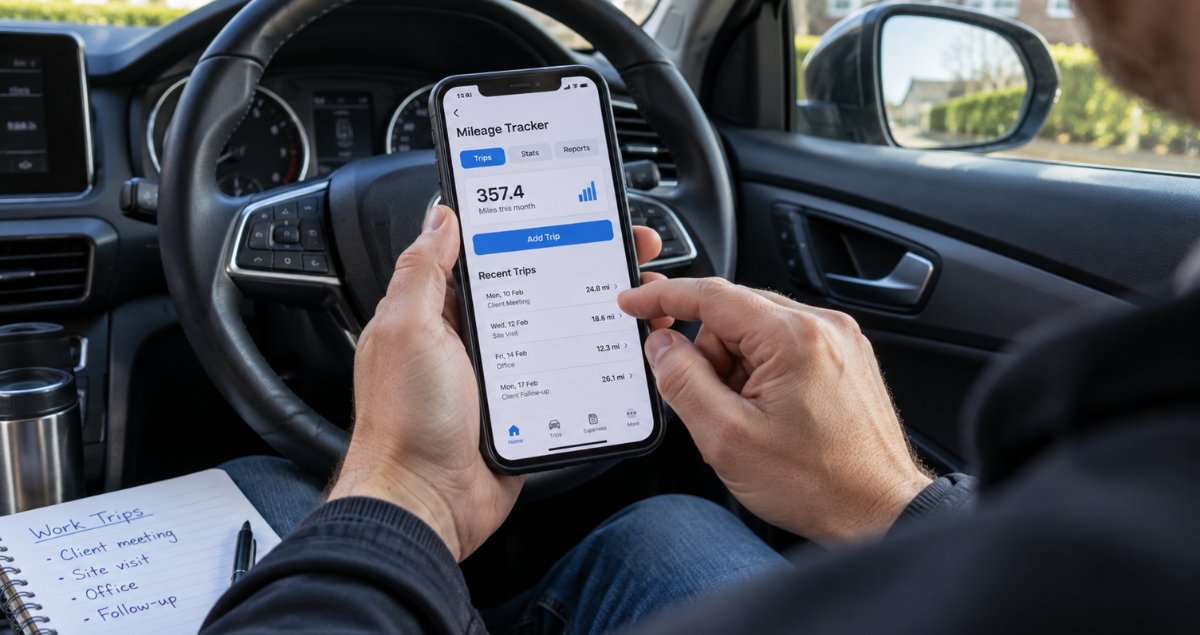
2Your own car, a company car, or a van?
If you drive your own car for business, mileage claims are how you're compensated. If you drive a company car instead, the system is entirely different — you generally can't claim AMAP mileage in the same way, since your employer typically reimburses fuel separately, often via Advisory Fuel Rates that are reviewed quarterly by HMRC. It's genuinely a different system, not just the same rate under a different name — check current rates directly with HMRC rather than assuming they match the mileage figures above.
If you're provided a company car for both business and any private use, that triggers Benefit-in-Kind tax, calculated differently again.
🚘 Use the Company Car Tax (BIK) Calculator →If you're weighing up buying a vehicle for the business rather than using mileage claims on a personal car, the finance decision matters just as much as it would for a personal purchase.
💳 Use the PCP & HP Car Finance Calculator →3Van-specific rules you need to know
Vans — Light Goods Vehicles up to 3,500kg — are taxed under a completely different VED system to cars. There's no CO2-based first-year rate the way cars have had since 2017; instead, most vans pay a single flat standard rate, with a reduced rate available for a specific window of Euro 4/5 compliant vans.
🚐 Use the Van Road Tax Calculator →Electric vans previously paid no VED at all — but since April 2025, they now pay the standard rate too, mirroring the same change made to electric cars. If you're budgeting for an electric van assuming free road tax, that assumption is out of date.

4City driving costs when driving is your job
For anyone who drives into cities regularly for work — tradespeople, delivery drivers, sales reps — congestion charges and parking fines can quietly become one of the largest ongoing costs of the job, precisely because they're incurred daily rather than as an occasional inconvenience.
🏙️ Use the Congestion Charge Calculator → 🅿️ Use the Parking Fine (PCN) Calculator →A Penalty Charge Notice paid within the 14-day discount window costs half of what it does if left — for a driver picking up occasional parking notices as a routine part of city work, that discipline alone can meaningfully affect the annual total.
5Fuel and EV costs at business mileage levels
Fuel cost matters more, proportionally, for high-mileage business drivers than for an average personal driver, simply because the same per-mile difference multiplies across a much larger number of miles each year. This is exactly where the choice between petrol, diesel, and electric has the biggest financial impact.
⛽ Use the Fuel Cost Calculator → ⚡ Use the EV vs Petrol Calculator →High-mileage drivers who can charge at home overnight tend to see the largest absolute savings from switching to electric, precisely because the per-mile cost gap is being multiplied across so many more miles than an average personal driver covers.
6Record-keeping mistakes that cost you at tax time
The most common issue HMRC queries around mileage claims isn't fraud — it's poor record-keeping. A mileage log needs to show the date, destination, purpose, and miles travelled for each business journey, kept contemporaneously rather than reconstructed months later from memory at tax return time.
- Mixing business and personal journeys without clearly separating them in your log
- Estimating mileage retrospectively instead of recording it at the time — HMRC can and does query implausible or round-number-heavy logs
- Claiming the mileage rate and separate fuel receipts for the same journeys — as covered above, this is double-claiming
- Switching between Simplified Expenses and actual costs for the same vehicle without understanding the restriction on doing so

7Self-employed vs employed: how claiming differs
If you're self-employed, you claim mileage through Self Assessment, choosing between Simplified Expenses (the flat mileage rate covered above) or actual costs — a proportion of your total vehicle running costs based on your genuine business-use percentage. You choose one method per vehicle, and once you've chosen actual costs for a specific vehicle, HMRC generally expects you to continue with that method for that vehicle rather than switching back and forth.
If you're employed and use your own car for work, but your employer pays you less than the approved mileage rate — or nothing at all — you can claim Mileage Allowance Relief on the shortfall through Self Assessment or a P87 form. This is a genuinely underclaimed benefit; a lot of employees who receive a lower "car allowance" style payment don't realise they can claim the difference back as tax relief.
Business driver checklist
- Mileage log kept contemporaneously, with date, destination, purpose, and miles for every journey
- Clear on whether you're using Simplified Expenses or actual costs for each vehicle — and not mixing the two
- Van VED confirmed against the correct category, not assumed to match car VED rules
- Congestion Charge and parking costs factored into the real cost of city-based work
- If employed and using your own car, checked whether your employer's mileage payment is below the approved rate
- Fuel/EV cost comparison run against your actual annual business mileage, not a generic average
Frequently asked questions
How much can I claim per mile for business driving in the UK?
45p per mile for the first 10,000 business miles in a tax year, then 25p per mile after that, for cars and vans. Motorcycles are a flat 24p per mile, and bicycles a flat 20p per mile.
Can I claim mileage and fuel receipts separately?
No. The mileage rate is all-inclusive, covering fuel, wear, and a contribution to insurance and depreciation. Claiming both for the same journeys is double-claiming.
Is van road tax the same as car road tax?
No. Vans use a mostly flat-rate VED system, structurally different from the CO2-banded system cars have used since 2017.
What if my employer pays me less than the approved mileage rate?
You can claim tax relief on the shortfall through Mileage Allowance Relief, via Self Assessment or a P87 form. This is a genuinely underclaimed entitlement for employees who use their own car for work.
Can I switch between Simplified Expenses and actual costs?
Generally not for the same vehicle, once you've chosen actual costs. Choose the method carefully at the outset, since HMRC expects consistency for that specific vehicle going forward.
All tools referenced in this guide
Sources
- HMRC — Travel — mileage and fuel rates and allowances
- HMRC — Simplified expenses if you're self-employed
- GOV.UK — Vehicle tax rate tables 2026
- Transport for London — Congestion Charge, discounts and exemptions
- GOV.UK — Advisory Fuel Rates for company car users