
UK Motoring Terms Explained: The Complete Glossary
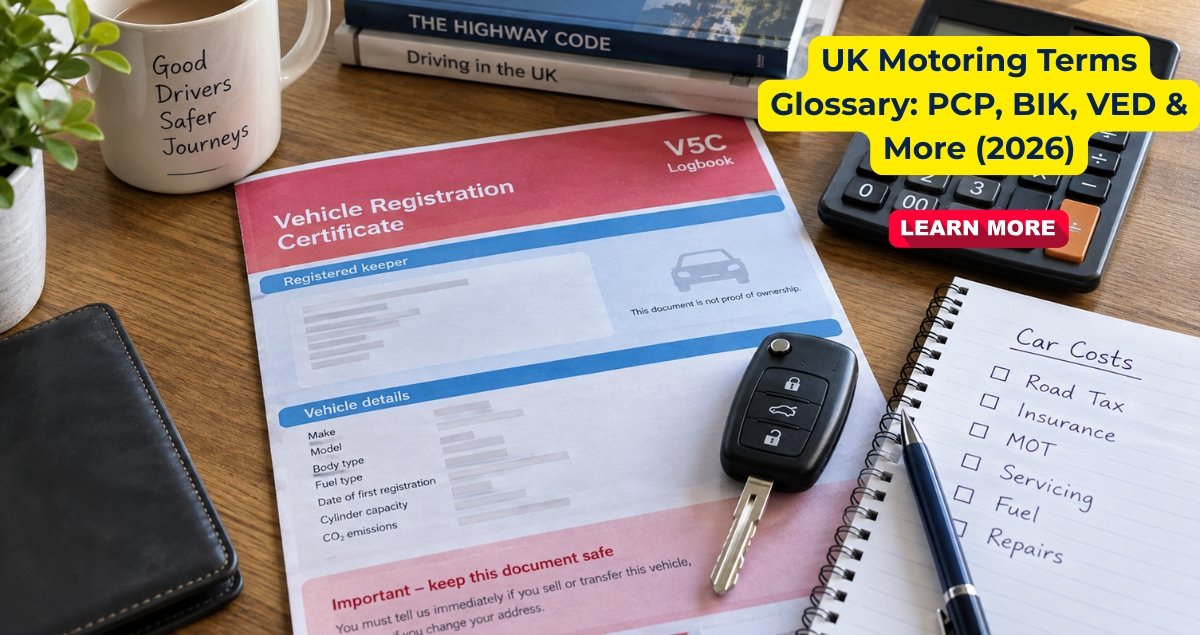
UK motoring is full of acronyms that get used constantly but rarely get explained: PCP, BIK, VED, i-Size and dozens more. This glossary defines them in plain English, grouped by category, with a link to the related calculator where one exists. Use the jump links above to go to a category.
Buying & Financing Terms
- APR (Annual Percentage Rate)
- The yearly cost of borrowing as a percentage, including interest and some mandatory fees. Use it to compare finance offers like for like.
- Representative APR
- The rate a lender must offer to at least 51% of the customers who are accepted for the advertised product. Up to 49% can be offered a higher rate, so it is a guide, not a personal quote.
- PCP (Personal Contract Purchase)
- A finance agreement where your monthly payments mostly cover the car's expected loss in value over the term, plus interest, rather than its full price. At the end you can usually pay the final payment (the balloon) to keep the car, return it, or part-exchange it, subject to the contract's conditions such as mileage and condition.
- HP (Hire Purchase)
- A finance agreement where you pay off the full price plus interest and own the car once the final payment is made. There is no balloon payment.
- Balloon Payment
- The final lump sum due at the end of a PCP agreement if you want to keep the car. It is usually set at the guaranteed future value agreed at the start.
- GFV (Guaranteed Future Value)
- The value the lender sets at the start of a PCP for the car at the end of the agreement. Some lenders call it the GMFV (Guaranteed Minimum Future Value). It is normally the amount of the final payment.
- Depreciation
- The loss in a car's value over time. It is often the largest single cost of owning a car, but it never arrives as a bill, so it is easy to leave out of a budget.
- P11D Value
- The car's list price including VAT, delivery charges and any optional extras, but not the first registration fee or the first year's vehicle tax. It is the figure Benefit-in-Kind tax is based on.
- No Claims Bonus/Discount
- A discount on car insurance that builds up for each year you don't make a claim. A claim can reduce or reset it, depending on the insurer.
- Telematics Insurance ("black box")
- An insurance policy where a device or app records how you drive. It is often offered to new drivers as a way to earn a lower premium by driving carefully.

Tax & Legal Terms
- VED (Vehicle Excise Duty)
- The official name for what is commonly called "road tax", an annual charge to keep a vehicle on the road. Rates are set out on GOV.UK.
- BIK (Benefit-in-Kind)
- Tax on a non-cash perk from an employer, such as a company car. It is worked out as a percentage of the car's P11D value and charged at the employee's income tax rate.
- OpRA (Optional Remuneration Arrangements)
- HMRC rules that apply from April 2017. Where an employee gives up salary for a benefit, the tax is worked out on the higher of the salary given up or the benefit's taxable value. Cars with very low emissions are treated differently, which is why salary sacrifice car schemes are mostly electric. This is a general summary, so check HMRC's guidance for the detail.
- Salary Sacrifice
- An arrangement where you give up part of your gross salary in exchange for a benefit, such as an EV lease. It can reduce the income tax and National Insurance you pay, depending on the scheme.
- AMAP (Approved Mileage Allowance Payments)
- HMRC's approved rates for business mileage in your own car or van. GOV.UK shows 55p a mile for the first 10,000 business miles from 6 April 2026 (45p before that date), then 25p a mile after that.
- Simplified Expenses
- A flat-rate method self-employed people can use to claim vehicle costs from their business mileage, instead of claiming actual running costs.
- Mileage Allowance Relief
- Tax relief an employee can claim if their employer pays less than the approved AMAP rate for business journeys in their own car.
- Advisory Fuel Rates (AFR)
- HMRC-published rates, reviewed regularly, for reimbursing company car drivers for fuel on business journeys. It is a different system from AMAP mileage claims.
- Expensive Car Supplement
- An extra annual VED charge for cars with a list price over £40,000 when new, paid on top of the standard rate for years 2 to 6. GOV.UK says the threshold for zero-emission cars registered from 1 April 2025 rises to £50,000 from 1 April 2026.
- SORN (Statutory Off Road Notification)
- A declaration to the DVLA that a vehicle is off the road. It means you don't have to tax the vehicle, but it must not be driven or parked on a public road while it is declared.
- Euro Emissions Standard
- An EU-derived classification (Euro 1 to Euro 6) of how clean a vehicle's exhaust emissions are. It decides whether a vehicle meets the rules of emissions zones such as the ULEZ and Clean Air Zones, and it can affect the tax class of some older vans.
- Historic Vehicle Exemption
- GOV.UK says that from 1 April 2026 you can apply to stop paying vehicle tax if the vehicle was built before 1 January 1986 (or, if the build date is unknown, first registered before 8 January 1986). The MOT exemption is separate: the vehicle must have been built or first registered more than 40 years ago and not had substantial changes. Exempt vehicles must still be taxed (at no cost) and kept roadworthy.
Penalties & Enforcement Terms
- FPN (Fixed Penalty Notice)
- A penalty from the police for a driving offence such as speeding, offered as an alternative to going to court. It can come with penalty points. It is different from a civil parking PCN.
- PCN (Penalty Charge Notice)
- A civil penalty issued by a council or TfL for a parking or certain moving traffic contravention. It never carries penalty points and doesn't go on your driving licence.
- Private Parking Charge Notice
- A charge from a private landowner or parking company, sometimes shortened to PCN as well. It is not a council penalty, it follows a different process and appeals route, and it does not carry penalty points.
- Charge Certificate
- A step up for an unpaid council PCN. In the council process we checked, the amount owed increases by 50%. The details can vary by council.
- New Drivers Act
- Rules under which a new driver's licence is revoked if they get 6 or more penalty points within 2 years of passing their first driving test. They would then have to reapply for a provisional licence.
MOT & Safety Terms
- MOT
- The annual roadworthiness test that most cars in Great Britain need from 3 years after first registration. It checks safety and emissions standards. The name comes from the former Ministry of Transport. Northern Ireland has its own system.
- i-Size (R129)
- A child car seat standard based on the child's height rather than weight. Children must travel rear-facing until they are over 15 months old.
- Stopping Distance
- The distance a vehicle travels from the moment the driver notices a hazard to a full stop: thinking distance plus braking distance. It grows faster than speed does.
- Provisional Licence
- A licence that lets a learner drive under supervision before passing their test. You need it to book the theory and practical tests.
- Theory Test
- A computer-based test of driving theory and hazard perception that you pass before you can book the practical test. The pass certificate is valid for 2 years.
- Vehicle History Check (often called an HPI check)
- A paid check on a used car's history. It can show outstanding finance, write-off records, mileage discrepancies and whether the car is recorded as stolen. HPI is one company's name that people use for the whole category.
- V5C (logbook)
- The official registration certificate for a vehicle, showing the registered keeper. It is not proof of ownership. The keeper must tell the DVLA when a car is bought or sold.
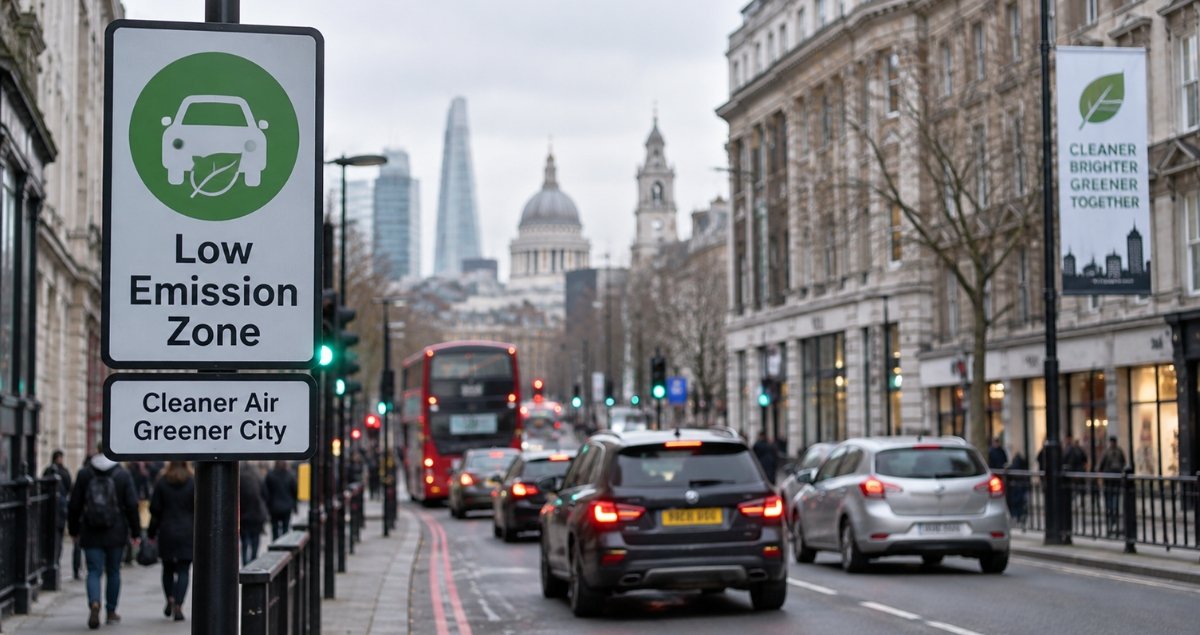
City & Emissions Zone Terms
- Congestion Charge
- A daily charge for driving in central London during set hours, run by Transport for London (TfL) and separate from national DVLA rules.
- ULEZ (Ultra Low Emission Zone)
- A London charging zone that covers all London boroughs. Vehicles that don't meet its emissions standard pay a daily charge. It is separate from the Congestion Charge and often confused with it.
- Clean Air Zone (CAZ)
- A charging zone in an English city outside London, with its own boundary and rules. GOV.UK lists four classes. Only Class D zones charge private cars.
- Low Emission Zone (LEZ, Scotland)
- Scotland's version of an emissions zone, in Aberdeen, Dundee, Edinburgh and Glasgow. Carwow reports that it issues penalty charge notices rather than banning vehicles, with Euro 4 for petrol cars and Euro 6 for diesel cars.
EV & Charging Terms
- kWh (kilowatt-hour)
- The unit of energy used for both an EV battery's capacity and the energy used when charging. It does for electricity roughly what litres do for fuel.
- Rapid / Ultra-Rapid Charging (DC)
- High-power public charging, usually 50kW and above, that is much faster than home AC charging. Speed often drops once the battery is around 80% full.
- Charging Taper
- The slowdown in DC rapid charging speed, often once the battery passes about 80% charge. The car's battery management system does this to protect the battery.
- Cleaner Vehicle Discount
- A discount that gave electric vehicles a full exemption from the London Congestion Charge. It ended on 25 December 2025, so EVs now pay the standard charge.
Rates and thresholds change, often at the start of the tax year in April. Where a definition quotes a figure, the date is given, but always check the official page for the current number.
Quick answers to the most-searched terms
What does PCP mean?
Personal Contract Purchase: a car finance agreement where monthly payments mostly cover the car's expected loss in value, with a final balloon payment if you want to own the car.
What does BIK mean?
Benefit-in-Kind: tax on a non-cash perk from an employer, such as a company car, worked out as a percentage of the car's list price (P11D value).
What does VED stand for?
Vehicle Excise Duty: the official name for what is commonly called road tax.
What's the difference between ULEZ and the Congestion Charge?
The ULEZ is an emissions-based daily charge covering all London boroughs. The Congestion Charge is a separate daily charge for driving in central London during set hours, and it is not based on emissions.
What is a PCN?
A Penalty Charge Notice: a civil penalty for a parking or certain moving traffic contravention, issued by a council or TfL. It never carries penalty points, unlike a police-issued Fixed Penalty Notice. Private parking companies issue their own parking charge notices under a different process.
Explore the calculators mentioned in this glossary
Sources
- GOV.UK — Approved mileage rates. 55p a mile for the first 10,000 miles from 6 April 2026, then 25p.
- GOV.UK — Expensive car supplement threshold increase for zero-emission vehicles. £50,000 from 1 April 2026.
- GOV.UK — Historic vehicles: vehicle tax and MOT exemption.
- Carwow — guide to Low Emission Zones in Scotland. A motoring site, so a secondary source.
- HMRC and Financial Conduct Authority guidance on OpRA, Benefit-in-Kind and representative APR. I could not re-load these pages on 18 October, so those definitions are general summaries.
- GOV.UK and TfL — general vehicle tax, MOT, driving licence, Congestion Charge and ULEZ guidance.

Prakash
Prakash is the founder and editor of UK Driving Tools. He maintains the site's calculators and guides and checks the rates and rules they use against official UK sources, such as GOV.UK, the DVLA, HMRC and Transport for London, before publishing.
Pages are drafted with the help of AI tools and then checked by the editor. He isn't a lawyer, accountant or UK-qualified adviser, so every page lists its sources and states what its calculator can't tell you. Nothing on this site is legal or financial advice.
Pages on UK Driving Tools are drafted with the help of AI tools. Before publishing, the figures and rules on each page are checked against the official source named on the page, and calculator examples are tested against the working formula. Pages are updated when rates or rules change. Our Editorial Policy explains the full process, including how to report a mistake.
Spotted a mistake or an out-of-date rate? Let us know and we'll check it against the official source.