
Historic Vehicle Tax Exemption Checker
Check whether your classic car qualifies for the rolling 40-year VED and MOT exemption — and exactly when it will if not yet.
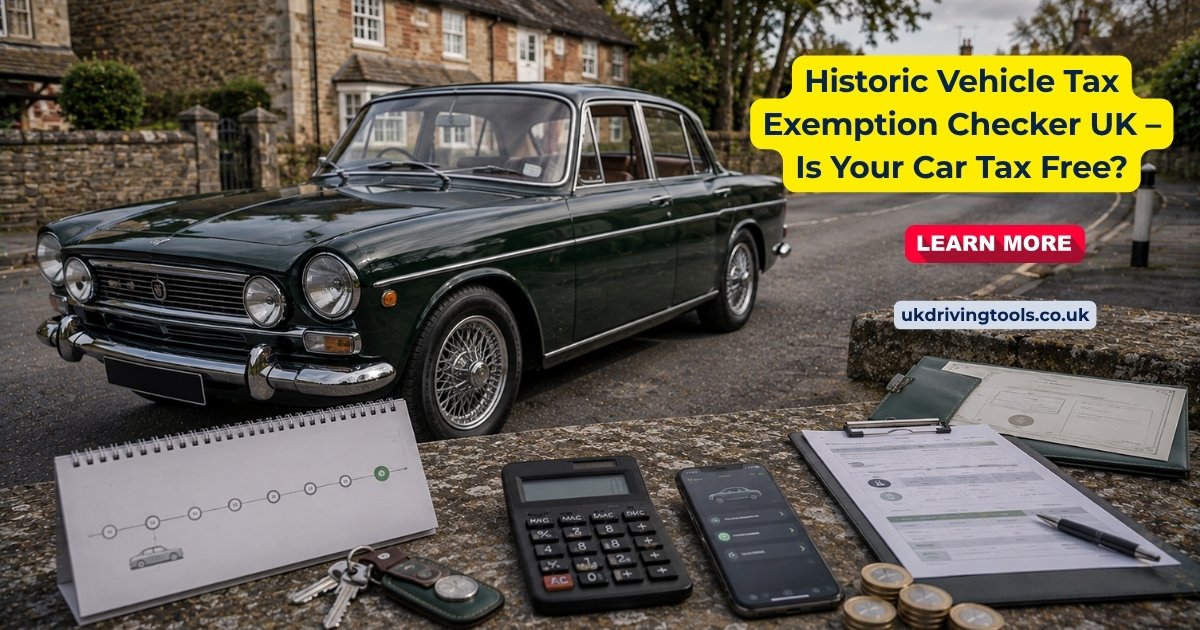
How the 40-year rolling exemption works
UK vehicles become exempt from paying VED once they turn 40 years old, but the exemption doesn't apply the moment your car hits its 40th birthday — it applies from the next 1 April after that birthday. This is why it's called a "rolling" exemption: the qualifying cutoff date moves forward by one year every 1 April, rather than being assessed individually on each car's exact anniversary.
In practical terms: a vehicle built at any point in a given calendar year becomes exempt starting from 1 April, 41 years later — not on its exact 40th anniversary.
3 worked examples
Example 1 — Comfortably exempt
A car manufactured in March 1980.
1 April 2021 (built 1980 + 41 years)
Result:Exempt — this date has long since passed
Example 2 — Not yet exempt
A car manufactured in June 1987.
1 April 2028 (built 1987 + 41 years)
Result:Not yet exempt — still needs to pay standard VED and have a valid MOT until that date
Example 3 — The common misconception
A car manufactured on 15 January 1986 — checked today (August 2026), which is over 40 years after the build date.
1 April 2027 (built 1986 + 41 years)
Result:Not yet exempt, even though the car is already more than 40 years old — the exemption doesn't take effect until the next 1 April, which in this case is still about 8 months away
Example 3 is the single most common point of confusion with this exemption. Being "over 40 years old" today doesn't automatically mean exempt today — the rolling 1 April cutoff means there's always a gap of up to a year between a vehicle turning 40 and the exemption actually applying.
VED exemption — still not automatic
Once your vehicle qualifies, VED itself becomes free — but you must still tax the vehicle every year, declaring it as exempt each time, exactly as you would with a paying vehicle. The DVLA doesn't automatically stop expecting a declaration just because the rate is £0. Missing this declaration means your vehicle is technically untaxed, with the same enforcement risk (clamping, fines) as any other untaxed vehicle, even though no money changes hands.
MOT exemption and "substantially changed" vehicles
Since 20 May 2018, vehicles that qualify for the 40-year VED exemption are usually also exempt from needing an annual MOT test — but only if the vehicle hasn't been "substantially changed" in the last 30 years. The DVLA's substantial change criteria include things like:
- Replacement of the chassis, monocoque bodyshell, or major structural components with a non-original type
- Changing the method of propulsion (e.g. engine type)
- Significant changes to the axles or suspension affecting the vehicle's handling characteristics
- A change in wheel or tyre size that alters the track
If your vehicle has been substantially changed, it remains subject to normal MOT requirements even though it may still qualify for the VED exemption — the two exemptions aren't automatically linked once modifications are involved.
What this checker can't tell you
Whether your specific modifications count as "substantial"
The DVLA's substantial change criteria involve some judgement — this checker takes your self-declared answer, but if you're genuinely unsure whether your vehicle's modifications qualify, check the detailed DVLA guidance or contact them directly before assuming either way.
Your vehicle's exact recorded date with the DVLA
The DVLA uses the date it has on record, which may be the date of first registration rather than the true manufacture date, particularly for older or imported vehicles. Check your V5C or the DVLA vehicle enquiry service for the date actually on record for your specific vehicle.
Insurance implications
Tax and MOT exemption are separate from insurance requirements — a historic vehicle still needs valid insurance to be driven, and some insurers offer specific classic car policies that may have their own mileage or usage conditions.
Common mistakes
Assuming "over 40 years old" means exempt today
As Example 3 shows, this is the most common error — the rolling 1 April cutoff means there's a gap between turning 40 and the exemption actually applying.
Forgetting to declare exempt tax annually
The exemption removes the cost, not the requirement to declare your vehicle's tax status every year.
Assuming MOT exemption applies regardless of modifications
A substantially changed vehicle can still owe VED at £0 while remaining subject to normal MOT testing — the two exemptions aren't automatically bundled together once significant changes are involved.
Using the wrong date
Using the date you bought the vehicle, rather than its actual manufacture or first registration date, will give a wrong result — always use the date the vehicle itself was built or first registered.
How to claim the exemption
- Declare exempt tax online or by phone when your current tax is due to expire, in the same way you'd renew paid tax — just select the historic vehicle exemption category
- Declare MOT exemption honestly if applicable — this is typically a self-declaration made when you tax the vehicle, confirming it hasn't been substantially changed
- Keep your V5C up to date, particularly if the recorded date of manufacture differs from what you believe is correct
- Consider a voluntary MOT anyway if you're unsure about a modification's status, or simply want an independent safety check even though not legally required
🔧 Not historic yet?
If your vehicle doesn't yet qualify, find out exactly when your next MOT is due in the meantime.
Use the MOT Due Date Calculator →How we calculate
Eligibility date = 1 April of (build year + 41). A vehicle is exempt if today's date is on or after this eligibility date.
VED exemption applies once the eligibility date has passed, regardless of modification status. MOT exemption applies under the same condition, but only if the "substantially changed" checkbox is not selected.
Frequently asked questions
When does a car become tax exempt in the UK?
From the 1 April that falls in the year the vehicle turns 41 years old (i.e. 41 years after its build year), not on its exact 40th anniversary. This is known as the rolling 40-year exemption.
Do I still need to tax an exempt historic vehicle?
Yes. You must still declare the vehicle's tax status every year, even though the rate is £0. Failing to do so means the vehicle is technically untaxed.
Do historic vehicles need an MOT?
Usually not, if they qualify for the 40-year exemption and haven't been substantially changed in the last 30 years, under rules that took effect from 20 May 2018. A substantially modified vehicle remains subject to normal MOT requirements.
What counts as "substantially changed" for MOT exemption purposes?
DVLA criteria include changes to the chassis or bodyshell, a change in propulsion method, significant suspension or axle changes affecting handling, and wheel or tyre changes that alter the track. Check the detailed DVLA guidance if you're unsure whether specific modifications apply.
Why isn't my 40-year-old car exempt yet?
Because the exemption uses a rolling 1 April cutoff, not the vehicle's exact 40th birthday. There can be a gap of up to a year between a vehicle turning 40 and the exemption actually taking effect.
References & data sources
- GOV.UK — Vehicles exempt from vehicle tax. Official rules on the 40-year rolling historic vehicle tax exemption.
- DVLA — MOT exemption for historic vehicles. Official guidance on the MOT exemption introduced from 20 May 2018, including the "substantially changed" criteria.
Always confirm your vehicle's exact recorded date and current exemption status via the DVLA vehicle enquiry service before relying on this estimate, particularly for vehicles with an uncertain manufacture date.